


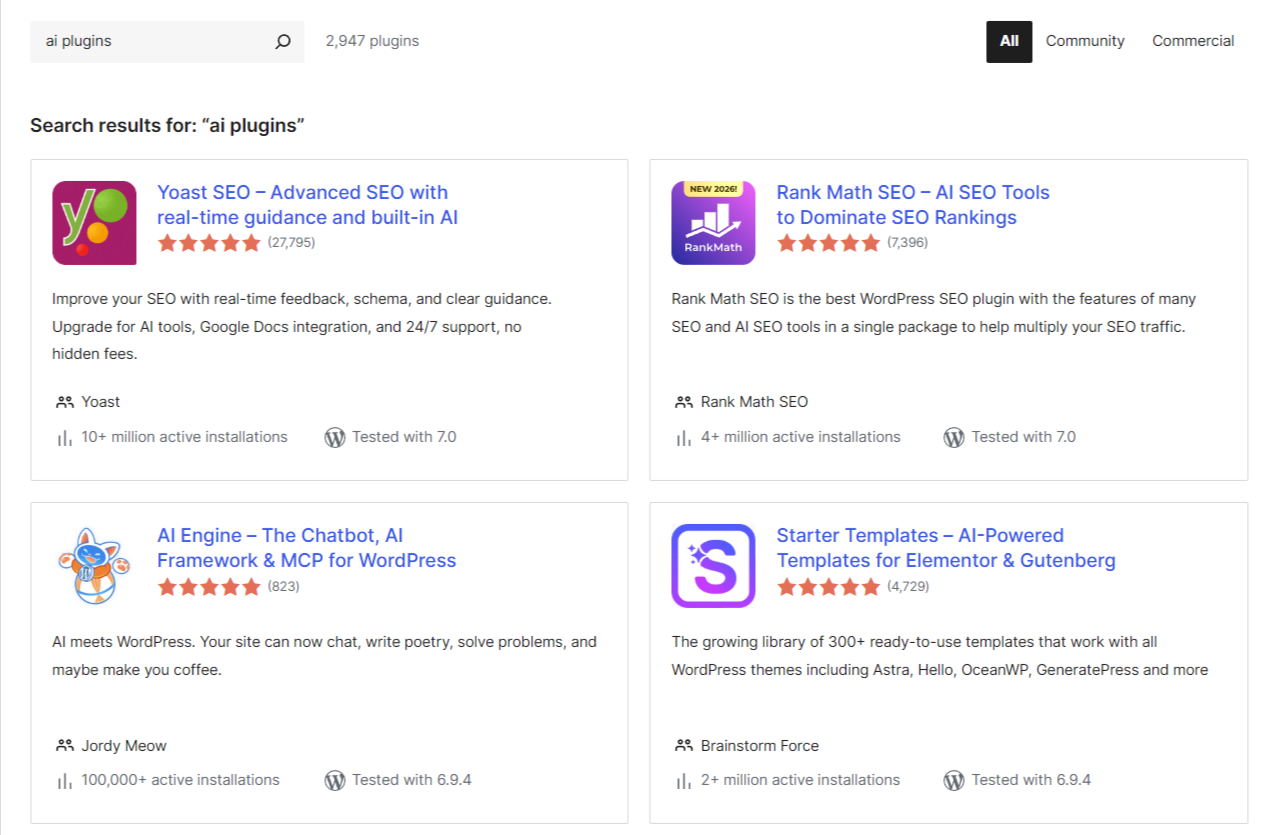
The WordPress landscape shifted in 2026. Sites that still rely on manual content creation, one-size-fits-all homepages, and generic email blasts are losing market share to competitors running lean, automated operations. Not because those sites are better marketed — but because they're faster to iterate, more responsive to user behavior, and generating more revenue per visitor.
The difference? AI infrastructure layered into their WordPress stack. Not for show. For revenue.
This guide covers what's actually working for US businesses right now — not pie-in-the-sky AI concepts, but specific implementations generating measurable returns on investment.
Why AI Adoption in WordPress Accelerated (And Why You're Behind If You Haven't Started)
The Market Reality in 2026
WordPress powers 43% of all websites, but the next competitive layer is determined by AI implementation speed. Sites with AI-driven workflows are publishing 3-5x faster. Sites with personalization are seeing 20-35% higher conversion rates. Sites with intelligent search are turning browsers into buyers at 3x the historical rate.
This isn't theoretical. Gartner reports that 35% of enterprises are actively piloting or deploying AI applications, up from 20% in 2024. For WordPress sites serving competitive industries, AI is no longer optional — it's the minimum viable competitive standard.
The 7 AI Features That Change WordPress Revenue Fundamentals
1. Automated Content Workflows: Turn Hours Into Minutes With WordPress AI
One of the biggest challenges for WordPress site owners is the time it takes to produce quality content. WordPress content automation is changing that equation entirely. Instead of spending days on a single blog post, teams are now publishing multiple pieces in the same timeframe.
The Old Way (Still How Most WordPress Sites Work): Marketer has idea → writes content → adds images manually → optimizes for SEO → creates social versions → publishes. Timeline: 3-5 days per piece. Bottleneck: human writing time.
The AI Way (2026 Reality): Marketer inputs topic + keywords → AI content creation generates first draft + outlines + social variations + optimized meta tags → human review + refinement → publish. Timeline: 4-6 hours per piece. Bottleneck: human judgment only.
What This Enables: A content team of 2 can now produce output that previously required 6-8 people. For WordPress automation workflows, this translates to: 4x blog post frequency, daily social media updates without hiring more staff, rapid response to trending topics, and dramatically improved SEO momentum from consistent publishing.
Tools That Work (WordPress Content Automation):
- Rank Math AI Pro ($15/month) — generates blog outlines, meta tags, SEO analysis directly in WordPress editor
- Jasper for WordPress ($125/month) — full-featured AI writing assistant WordPress with native integration
- OpenAI API + custom WordPress plugin ($50-300/month API costs) — maximum flexibility for WordPress AI automation, requires technical setup
Implementation Cost: $15-300/month in tools + 4-8 hours setup time + ongoing human editing.
ROI Reality: A WordPress blog publishing 2x as frequently typically sees 30-50% increase in organic search traffic within 90 days. For a site generating $20K/month from organic, that's $6-10K in additional monthly revenue from automated content creation alone.
2. Intelligent Personalization Engine: WordPress Personalization That Converts
The Problem Personalization Solves: A returning customer should not see the same onboarding message as a first-time visitor. A high-intent visitor (clicked on pricing page) should not see the same CTA as a casual browser. A mobile user experiences different friction than a desktop user. Yet 87% of WordPress sites treat everyone identically.
What Changes with AI-Powered Personalization: WordPress personalization plugins detect visitor type in real-time — returning vs new, device type, traffic source, time spent on previous pages, previous purchases — and serves dynamically optimized content instantly. A returning customer sees upsell recommendations. A first-timer sees trust signals. A Google Ads visitor sees the value prop. A mobile user sees touch-optimized layouts. This is dynamic content WordPress at its finest.
Engagement Impact Data: Sites implementing visitor segmentation see 20-35% bounce rate reductions, 15-25% increase in pages-per-session, and 10-20% conversion rate improvement. For e-commerce, this compounds: 10% conversion improvement on $100K/month revenue = $10K additional monthly revenue.
WordPress Personalization Implementation (No Developer Needed):
- Metorik for WooCommerce — Personalized product recommendations based on visitor behavior ($49/month)
- Unbounce — Dynamic landing pages that personalize by traffic source, device, referrer ($99/month)
- OptinMonster — WordPress personalization plugin with AI-powered forms that show different CTAs to different visitors ($19-99/month)
Developer-Powered Advanced Version: WordPress REST API + React/Vue frontend + machine learning model analyzing visitor behavior. Cost: $5-10K initial build, then operational costs only.
Conservative ROI Estimate: 15% conversion rate optimization WordPress improvement on 1,000 monthly visitors at $50 average transaction value = $7,500 additional monthly revenue. Payback period: 2-3 months.
3. Conversational AI That Handles Support at Scale: WordPress Chatbot That Works
Why Most WordPress Chatbots Fail: They're overtrained on product descriptions and undertrained on real support conversations. Visitors ask edge cases, get looped responses, and bounce. Result: chatbot damage → support queries spike → support overwhelmed.
What's Different About AI Chatbots in 2026: Modern WordPress chatbot solutions (using Claude, GPT-4, or similar) understand context better. They know when to escalate to humans. They learn from conversations. They handle 60-70% of support volume without frustrating users, which is the real metric (not "answer 100% of questions"–that's unrealistic).
The Support Load Reality: A typical AI customer service WordPress site supporting 10,000+ visitors/month receives 150-300 support inquiries monthly. At $15/hour support staff cost, that's $375-750/month in labor. An AI chatbot WordPress handling 60% of that load costs $50-200/month in API charges. Cost reduction: $225-450/month. One chatbot pays for itself in days.
What Visitors Actually Ask (What Your Chatbot Should Handle):
- Password resets & account access (22% of inquiries)
- Billing & refund questions (18%)
- Product information & specs (19%)
- Shipping & delivery status (15%)
- Returns & warranty (12%)
- Complex/custom requests (14%) ← escalate to human
Train your chatbot WordPress on these five categories, and it handles your realistic volume with AI customer support automation.
Tools (Ranked by Ease for WordPress):
- WP Chatbot by Userflow — No-code WordPress chatbot plugin builder in WordPress dashboard ($49-199/month)
- Drift — Sales-focused AI chatbot with lead qualification ($500/month and up)
- Custom Claude/OpenAI API implementation — Most flexible but requires developer ($50-300/month API costs)
Real-World Result: An e-commerce WordPress site with 8,000 monthly visitors deployed a basic chatbot for WordPress covering the five categories above. Support inquiries dropped 35%, support response time fell from 24 hours to instant, and customer satisfaction scores increased 12%. Year 1 costs: $1,200 (chatbot) + $2,400 (API). Year 1 support labor savings: $5,400. Net benefit: $1,800 in year 1.
4. Hyper-Targeted Content Recommendations: WordPress Content Strategy That Keeps Readers Engaged
The "Related Posts" Problem: Most WordPress sites show related posts based on category or tag. This is often irrelevant. A visitor reading "Best Laptop for Video Editing" gets shown "Best Budget Laptops" (wrong intent) instead of "Video Editing Software Recommendations" (right intent). Result: 85% of visitors leave instead of exploring further. This is where WordPress content recommendations powered by AI make a massive difference.
How AI-Powered Recommendations Work (The Real Implementation): The system doesn't just look at categories. It analyzes: (1) the current post's semantic meaning (what is it really about, not just its tags), (2) what similar readers engaged with, (3) which content pieces drive the most conversions, (4) the specific visitor's reading history. Then it recommends the next piece most likely to move that specific visitor down the funnel. This is smart related posts in action.
Result of Smart Recommendations: "Next page" clickthrough rates jump from 2-5% (typical WordPress) to 15-30% (AI-recommended). For a content site generating revenue from ads or affiliate links, this compounds. 100 daily readers × 25% clickthrough increase × 3.5 additional pages per session × higher ad/affiliate revenue = 20-30% revenue increase from one feature.
Why This Matters More Than You Think: Google's algorithm rewards "time on site" and "pages per session" as engagement signals. WordPress content recommendations don't just earn more from visitors — they also rank better for competitive keywords. It's a compounding advantage that improves your pages per session improvement metrics.
Tools for WordPress Content Strategy:
- Pinecone + OpenAI API + custom widget (Most flexible, $0-100/month Pinecone + $50-150/month OpenAI, requires development)
- Bloom (by Automattic) — WordPress-native WordPress recommendation engine ($0 for basic, paid upgrades available)
- Amazon Personalize integration (Enterprise solution, $5-50K setup)
For Most WordPress Sites: The most practical route is a custom WordPress widget using the OpenAI API to generate recommendations. Setup: 8-12 hours developer time ($1,200-1,800 if outsourcing). Ongoing cost: $50-150/month. ROI: 20-30% boost to pages-per-session typically justifies the investment within 2-3 months with AI recommendations WordPress implementation.
5. Semantic Search That Actually Understands Intent: WordPress Search Optimization With AI
The Broken Keyword Search Problem: A visitor on an e-commerce site searches "comfortable summer outfit" but gets results for "comfortable shoes" and "summer dresses" — not coordinated outfits. Another search: "something under $100 for gifting" returns products over $100. Keyword matching is precision-based, not intention-based. This is where semantic search WordPress solutions change everything.
How Semantic Search Changes This: Instead of matching keywords, intelligent product search understands meaning. "Comfortable summer outfit" returns coordinated clothing sets, beach wear, lightweight fabrics. "Something under $100 for gifting" filters products by budget and gift-appropriateness, not just price tag. This is true WordPress search optimization with AI at the core.
Conversion Impact: Sites deploying semantic search implementation typically see 40-60% improvement in search-initiated conversion rates. Why? Because visitors find what they're actually looking for, leading to better search conversion optimization.
Real Example: An WordPress e-commerce site with 8,000 SKUs switched from basic keyword search to semantic search WordPress powered by Algolia. Search-initiated conversion rate improved from 2.1% to 4.3% within 60 days. Their average order value from search traffic was $85. The improvement meant: 8,000 monthly search visitors × 2.2% conversion improvement × $85 AOV = $14,960 additional monthly revenue.
Implementation for WordPress (Easiest to Hardest):
- Algolia + Algolia Search plugin ($0-500/month depending on search volume, no developer needed)
- SearchWP Elite ($199 license + setup time) — WordPress search optimization tool
- Custom Elasticsearch implementation (Most powerful, requires developer, $200-1000+ setup)
Conservative ROI: 1% conversion improvement on 5,000 monthly search visitors at $50 average transaction = $2,500 monthly revenue increase. Setup costs: $500-3,000. Payback period: 1-2 months for high-traffic sites using AI search implementation strategies.
6. Automated Accessibility at Scale: WordPress Image SEO With AI Alt Text
The Alt Text Problem (And Why It Matters More Than Most Realize): Legally: ADA lawsuits for inaccessible WordPress sites have increased 240% since 2020. Practically: 1.3 billion people globally have vision impairments. From a Google perspective: images without proper alt text are invisible to search engines — you're leaving WordPress image SEO value on the table.
The Real Issue: Most WordPress sites have poor or missing alt text. Reasons: time-consuming to write, easy to forget, considered "nice-to-have" rather than essential. Result: 60-70% of images on typical WordPress sites have missing or generic alt text. Automated alt text generation solves this systematically.
How AI Changes This: Modern image recognition models analyze image content and generate contextually accurate alt text automatically. The text isn't obviously AI-generated (it's not "photo of [object]" spam). It reads naturally and contextually describes the image in a way that makes sense to screen readers and search engines. This is the power of WordPress alt text generator technology.
What Proper Alt Text Does:
- Legal compliance: Removes ADA compliance WordPress violation risk (saves $10-50K in potential lawsuit costs)
- SEO improvement: Image search traffic increases 20-30% with proper alt text
- User experience: Screen reader users can access your content with image accessibility AI
- Ranking signals: Google uses alt text for relevance signals
WordPress-Native Tools (Alt Text Automation):
- Rank Math (with Image SEO module) — Auto-generates alt text based on image analysis ($15/month)
- Imagify + alt text generation — Image optimization + automatic alt text generator ($9.99/month basic)
- Custom implementation using AWS Rekognition or Google Cloud Vision API (Most control, $50-300/month API costs, requires developer)
The Time Savings Are Real: Manually writing alt text for an image-heavy WordPress site takes 30 seconds per image. For a site publishing 10 images/week, that's 5 hours/month. Automated alt text saves 80% of this time. One person's hours recovered: 4 hours/month = $500/month in labor cost saved (at $15/hour rate).
Bonus (That Most People Miss): Sites with comprehensive alt text typically see 25-40% increase in image search traffic (Google Images). For visual-heavy WordPress sites (photography, design, fashion), this is a significant traffic source.
7. Multilingual WordPress Without the Technical Headache: AI Translation for Global Growth
The Multilingual WordPress Paradox: 75% of WordPress sites serve English-only audiences, even though 72% of internet users speak languages other than English. Most sites don't go multilingual because it's perceived as complex and expensive (hiring translators, managing translation plugins, dealing with layout issues in different languages). Multilingual WordPress solutions change this narrative entirely.
How AI Changes This (And Why It's Actually Good Now): Modern translation AI (from services like Google Translate, DeepL, or custom LLM implementations) understands context, idiom, and cultural nuance far better than keyword-substitution translation from 5 years ago. When combined with human editing (which catches 5-10% of errors that need cultural adjustment), you get 95%+ translation quality at 10% of traditional translator costs. This is automatic translation WordPress done right.
The Revenue Opportunity Most WordPress Owners Miss: Adding Spanish language content can increase traffic 20-30% (in US markets). Adding Portuguese increases reach in Brazil. Japanese increases reach in Japan and Asian markets. Each language unlocks an entire audience. For any WordPress site with products or services, WordPress multilingual reach often means 50-100% traffic increase for modest effort.
Modern Multilingual WordPress Implementation (AI Translation):
- WPML (WordPress Multilingual) — WordPress-native plugin handling language switching, automatic translation WordPress, and SEO ($39-499/year depending on features)
- Polylang + automatic translation API (Free plugin + API costs, more manual but cheaper overall)
- Weglot — Zero-code translation plugin for multilingual WordPress sites ($8-240/month depending on traffic)
The Real Process (That Actually Works with AI Translation):
- Deploy plugin (WPML or Weglot) — 1 hour setup
- Choose languages to target — 30 minutes market research
- Auto-translate existing content via AI — 5-10 minutes (automatic)
- Human review of 10-20% of translated content — 2-4 hours (catches edge cases, cultural issues)
- Publish new content in primary language, auto-translate, minimal review — 30 minutes per piece with AI translation for WordPress
Cost Comparison: Traditional Translation vs AI-Assisted (WordPress Multilingual):
- Traditional (hire native speaker translator): $200-400 per 1,000 words, 2-week turnaround
- AI-assisted with human review: $30-50 plugin cost per month, 2-hour human review per 10,000 words
For a 100-post WordPress blog translated to 3 languages:
- Traditional: 300,000 words × $0.30/word = $90,000, 20 weeks to complete
- AI-assisted: $49/month WPML + 200 hours human review at $25/hour = $5,049 + ongoing monthly maintenance
- Savings: $85,000, time: weeks instead of months
SEO Benefit (Often Overlooked): Google rewards multilingual site builder strategies with signals that suggest authority and reach. A site available in 3 languages ranks higher (all else equal) than a site in one language. Plus, you access keyword volume in other languages that your competitors haven't claimed yet.
Real-World Example: A US-based SaaS WordPress site added Spanish translation using automatic translation WordPress tools. Spanish-language traffic increased 180% within 60 days. 15% of Spanish-language visitors converted (same as English), expanding addressable market by 15%. For a $10K/month revenue business, that's $1,500/month additional revenue from 2 weeks of implementation work.
The Implementation Roadmap: Prioritize by Impact-to-Effort Ratio
Phase 1 (Weeks 1-4): Quick Wins That Deliver Immediate Results
Start Here (Ranked by Implementation Speed):
- Automated alt text generation (2-4 hours setup, $15/month) — Immediate legal risk reduction + SEO bump
- Automated content creation assistance (4-8 hours setup, $15/month) — Start publishing 2x faster
- AI chatbot for support (4-6 hours setup, $50-200/month) — Cut support costs 35%+ immediately
Total Phase 1 Investment: 10-18 hours implementation, $80-220/month in tools.
Expected Phase 1 Results: 30% faster content publishing, 35% support cost reduction, 20-30% increase in image search traffic.
Phase 2 (Weeks 5-12): Medium-Complexity Implementations with Higher ROI
Add These Once Phase 1 Is Stable:
- Semantic search (Algolia or SearchWP) — $0-500/month, 8-12 hours setup if customizing
- Intelligent content recommendations — $0-150/month in tools + 8-12 hours development (or use Bloom)
- Multilingual content — $50-240/month in tools, 4-6 hours initial setup
Expected Results: 40-60% improvement in search conversion rates, 25-30% increase in pages-per-session, 50-100% traffic increase from new language markets.
Phase 3 (Month 4+): Advanced Personalization for Maximum Revenue Impact
Deploy After You Have Data: Personalization engines need visitor behavior data to work effectively. Implement this after Phases 1-2 are generating real traffic patterns.
- Dynamic personalization (Metorik, OptinMonster) — $50-300/month
- Advanced audience segmentation — Custom development, $3-8K setup
Expected Results: 20-35% conversion rate improvement, 15-25% bounce rate reduction, highest ROI feature overall.
Realistic Total Cost & ROI Timeline
If implementing all 7 features strategically over 4 months:
Tool Costs (Monthly Recurring): $100-600/month depending on feature sophistication
One-Time Implementation: $2,000-5,000 (if outsourcing development for custom features) or 40-60 hours internal staff time
ROI Timeline:
- Month 1-2: Break-even on tool costs (faster publishing, support savings cover tools)
- Month 3: 15-25% revenue increase from semantic search + personalization
- Month 4+: Compounding benefits as data accumulates, 30-50% revenue increase is realistic for sites starting from zero AI
Example Math (WordPress Site Generating $20K/Month):
- Month 1-2: Break-even (tool costs covered by support savings + publishing efficiency)
- Month 3: +$3,000/month (semantic search improving search conversion by 2%)
- Month 4: +$6,000/month (personalization + recommendations improving conversion by 4%, 2x publishing frequency = more organic traffic)
- Month 6+: +$8-12,000/month sustainable increase
Year 1 additional revenue: $50K-100K. Year 1 tool + implementation costs: $10-25K. Year 1 net gain: $40-85K.
The Competitive Reality (Why This Matters Urgently)
WordPress site owners who implement these features in Q2 2026 will have 18-24 months of compounding advantage over competitors who wait until 2027-2028. By then, AI-powered personalization will be table stakes. Starting now means being ahead of the curve.
For US-based WordPress businesses competing in saturated markets (e-commerce, SaaS, digital services), these AI features aren't "nice to have." They're the difference between gaining market share and losing it to faster-moving competitors.
The question isn't "should I implement AI in WordPress?" anymore. It's "how quickly can I implement it before my competitors do?"
If you're ready to move faster than your competition, let's discuss which features make sense for your specific business model and timeline →
